MITSUBISHI ELECTRIC Changes for the Better

Beyond compliance: integrated safety for smart manufacturing

Machine safety is a mandatory requirement under European regulations such as the Machine Directive. With the Mitsubishi Electric iQ-R Safety PLC, this legal obligation becomes a competitive advantage—integrating safety and standard control in a single high-performance platform to simplify engineering, reduce wiring, and increase machine uptime.

Advancing safety beyond standards for smart manufacturing

Machine safety is a legal and ethical necessity: it is a mandatory requirement under European regulations like the Machinery Regulation (EU) 2023/1230 (which replaces Machinery Directive 2006/42/EC from Jan 2027). Every machine builder must implement the required safety measures to ensure regulatory compliance and legally place their machines on the market.

But compliance is just the starting point.


The way you implement safety defines your operational efficiency. A standalone, hard-wired relay system may be compliant, but it's often costly to wire, difficult to diagnose, and inflexible to change.
Mitsubishi Electric provide integrated safety solutions that merge automation and safety into one intelligent, interactive system. We believe in integrated safety: a single ecosystem where your automation and safety systems work together. This approach ensures compliance with ISO 13849-1 Category 4, PL e and IEC 61508 SIL 3 — and at the same time unlocks new efficiencies. It protects your employees, ensures compliance, and turns a legal obligation into an efficient, data-rich component of your smart factory.

Explore our integrated safety ecosystem

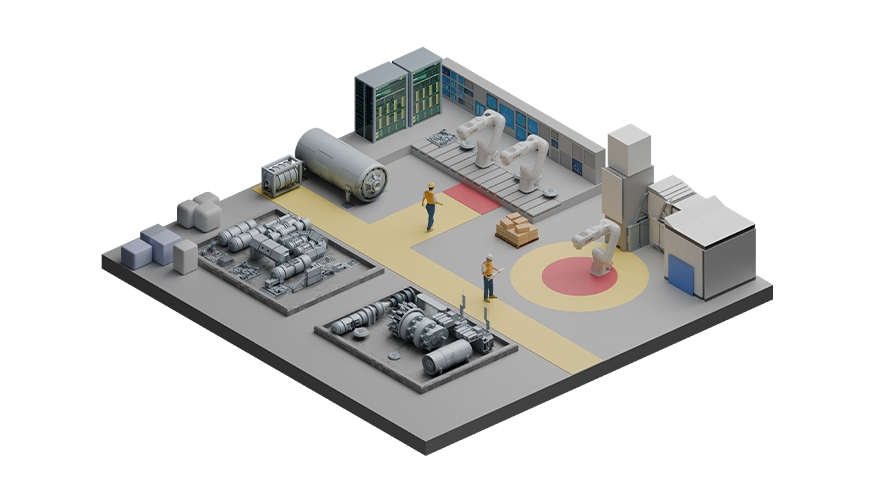
Gain full visibility of safety‑related events by monitoring all connected assets through your central control system. While safety functions themselves remain outside the controller, you can still track critical processes, identify exactly where an emergency‑stop or light‑curtain event occurred, and cut diagnostic time dramatically. With GOT/HMIs and Genesis visualization platforms, you can log issues faster, react sooner, and continuously improve machine performance.
Embed safety logic in your drives and robots for fast, reliable protection, all communicating over a single secure CC‑Link Safety network.
Build a robust and scalable safety foundation with integrated, high‑performance devices and components designed for modern industrial automation

Find the safety architecture that fits your specific needs

When implementing essential safety systems, you can choose from several architectures. While there are different ways to ensure compliance, an integrated approach proves to be the most efficient. Here’s how the options compare.

Level 1: conventional relay logic
For small scale solutions, a hard‑wired setup offers a straightforward and dependable solution. Its simplicity keeps everything easy to understand, and issues can often be identified directly at the source without the need for advanced tools or programming. When high‑level safety architectures aren’t required, this approach provides a practical, compliant, and accessible way to keep machines running smoothly.

Level 2: Level 2: centralized safety controllers

This approach offers a flexible step forward by shifting logic into a compact, stand‑alone controller with an intuitive graphical programming interface. It operates independently when no PLC is required and can be added easily whenever additional functionality is needed. Sensors and e‑stops connect directly to the unit, keeping the setup straightforward and allowing the system to grow or adapt without major redesign.

Level 3: integrated & decentralized safety management
Safety I/O modules can be used in both centralized and decentralized architectures, giving customers the freedom to choose the setup that fits their application best. Placing the modules closer to the application reduces wiring effort, speeds up installation, and makes future expansion extremely simple. With TSN‑based safety, a single safety PLC can coordinate servo drives, robots, inverters, and safety signals alongside standard I/O. This creates a unified platform for machine‑ and even line‑level control, enabling faster diagnostics, smoother integration, and a highly scalable safety concept.


From compliance to performance: rethinking machine safety

Compliance with legal standards is an important goal. However, a conscious investment in an integrated approach to safety provides powerful operational benefits that go far beyond what basic safety relays offer.

Achieve optimal performance

Bet on fast, reliable reaction times by integrating safety logic directly into the machine control system, ensuring personnel protection.

Pinpoint faults in seconds, not hours

Stop wasting time searching for a tripped e-stop. Our integrated systems use advanced visualization tools like GOT/HMIs and GENESIS to instantly show your operators the exact location and status of any safety event, drastically reducing diagnostic downtime.

Reduce engineering & wiring costs

With one engineering suite you can program both safety and automation programms. Further replace complex, labor-intensive hard-wiring with a clean, decentralized architecture. A single secure network, like CC-Link IE TSN Safety, reduces components, cabinet space, and commissioning time.

Scale with confidence

Mitsubishi Electric's offering covers everything: from simple, standalone machine applications to fully decentralized, network security concepts throughout the entire plant.